Arlington's $300 Condo Fee Hides a Bill Nobody Can Vote Down Anymore
August 27, 2026
August 27, 2026
What happens when the people who own a building lose the right to vote on how much they'll pay to fix it?
That question used to be theoretical for Arlington condo owners. It isn't anymore. A 2024 change to Virginia law quietly removed a protection that condo buyers have relied on for decades without ever having to think about it: the right of unit owners to vote down or shrink a special assessment. If you're comparing a $300-a-month HOA fee in an older Ballston or Courthouse building to a $1,200-a-month fee in a newer high-rise and treating the difference as pure savings, you're pricing the unit against a rulebook that no longer exists.
For years, Virginia's Condominium Act gave unit owners a specific check on their board's spending power. If a board levied a special assessment, owners could call a meeting within 60 days of the notice and, with a majority vote, rescind it or cut it down. It didn't matter whether the assessment was for a new roof, a garage deck repair, or an elevator overhaul. Owners had a formal, statutory off-ramp.
That off-ramp is gone for the assessments that matter most. House Bill 1209, passed in 2024, amended six sections across Virginia's Property Owners' Association Act and Condominium Act. The specific language that used to let owners rescind or reduce a special assessment lived in the additional-assessment provisions of both acts, Code section 55.1-1825 for property owners' associations and 55.1-1964 for condominiums, and HB 1209 stripped that language out for assessments used primarily to maintain, repair, or replace capital components. The board now has discretion to meet those obligations through reserves, additional assessments, or borrowed funds, full stop. There's no owner vote standing between the board's decision and your bill.
Legal commentary on the change has been blunt about why lawmakers did it. Firms tracking the 2024 session, including Whiteford, Taylor & Preston, point to the Surfside, Florida collapse as the reason the legislature acted, closing off the possibility that a cash-strapped board could be blocked from funding a structural repair by a vote of owners who didn't want to pay for it.
A board that used to need your permission to raise money for a new roof no longer does, as long as the money is going toward the building's capital components.
That's a reasonable policy response to a real safety problem. It's also a fact that almost nobody explains to a buyer signing a contract on an older condo in Arlington.
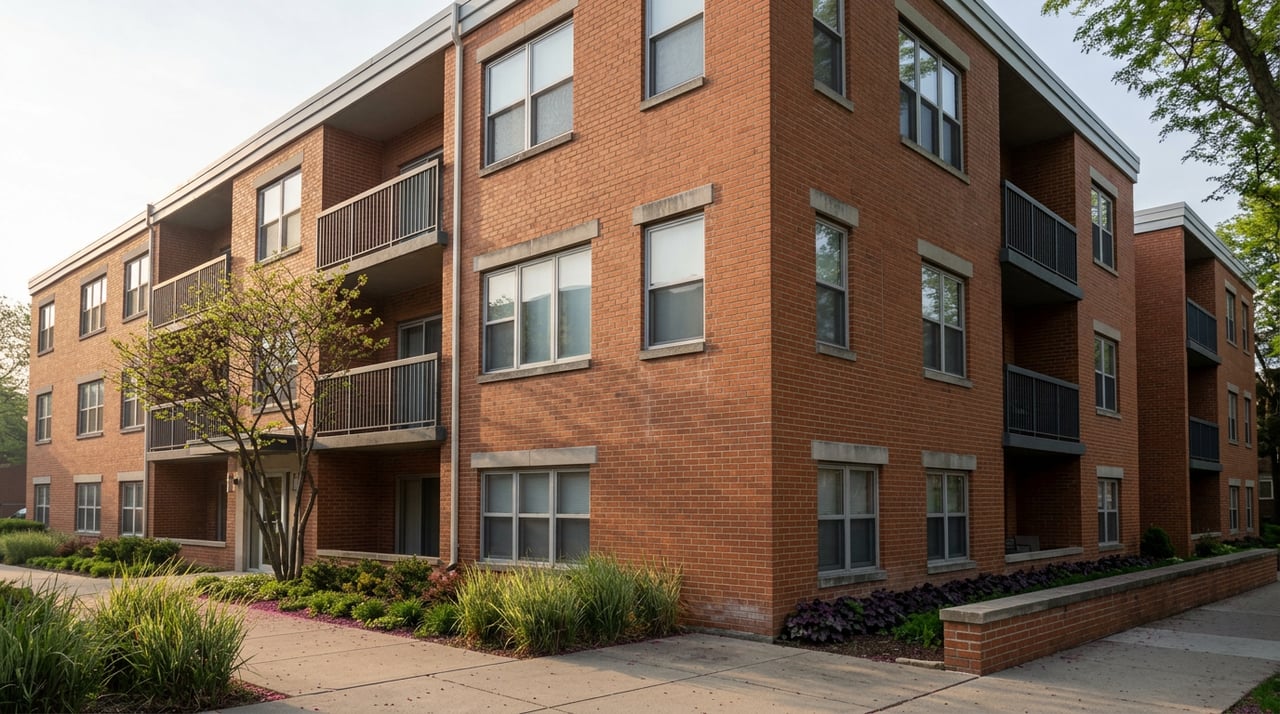
Arlington's condo stock spans two very different eras. The Rosslyn-Ballston corridor and the Crystal City and Pentagon City area include a mix of older garden-style buildings alongside newer high-rises. Monthly fees across that range swing from roughly $300 for older garden-style units up to $1,200 or more in amenity-heavy newer towers, a spread wide enough that two buyers shopping the same price range can end up looking at buildings with almost nothing in common structurally.
The newer end of that spectrum has had less time to accumulate deferred maintenance. Arlington hasn't had a new-construction condo deliver in some time. According to ARLnow's coverage of the local condo market, 2000 Clarendon delivered in 2022 aimed at the mid-market, and The Pierce at 1781 N Pierce Street sold out in 2024, after which no new luxury condominium has come to market anywhere in Arlington. Buildings from that generation are still working through their first major capital cycles.
Older buildings are a different story. Roofs, garage decks, elevators, and facades on a decades-old structure are often at or past the point where a reserve study should be recommending real money, not a modest annual bump. Under Virginia Code section 55.1-1965, condo boards are required to commission a reserve study at least once every five years and review it annually, but the law sets no minimum funding percentage. A board can be fully compliant with the letter of the law while running a reserve fund that covers a fraction of what an engineer says the building will need.
That combination, an aging building and a board that no longer needs owner buy-in to assess for capital repairs, is exactly the scenario the 2024 law was built for.
There's a financing shift stacked on top of the legal one, and it has a specific date attached: January 4, 2027.
Starting with loan applications dated on or after that day, Fannie Mae and Freddie Mac will require condo associations to direct at least 15 percent of their annual assessment income into reserves, up from the 10 percent floor that's been standard for years. Buildings that fall short risk losing their "warrantable" status, the designation that allows buyers to get a standard conventional mortgage there. There's a narrow exception: associations with a reserve study completed in the past three years, funded at that study's highest recommended level, are exempt from the flat 15 percent rule.
Losing warrantable status doesn't just complicate one buyer's closing. It affects every owner in the building, because it narrows the pool of financeable buyers down to cash purchasers and whatever non-conforming loan options remain, which typically means lower offers and longer time on market for everyone trying to sell there. A board's decision to underfund reserves in 2026 can show up as a discount on every unit's resale value in 2027, whether or not that particular unit ever gets hit with a special assessment.
For a buyer financing a purchase today, this isn't an immediate dealbreaker. The rule doesn't apply retroactively, and August 2026 closings are governed by the current standard. But anyone buying into an older building with a normal holding period is buying into a building that will be measured against the 15 percent bar well within their ownership window, and that measurement will show up in resale financing long before most owners think to check for it.
If you're looking at a condo in one of Arlington's older buildings, a few extra questions in the resale certificate review can save you from an unpleasant surprise:
The same shift changes the calculus for sellers, not just buyers. If your building hasn't had a reserve study in the last few years, or if the last one showed a funding gap, get ahead of it before you list. A buyer's agent working through the checklist above is going to ask the same questions you'd rather answer on your own terms, with time to explain context, than have surface as a surprise during due diligence. And when a request for the resale certificate comes in, respond within that 14-day window. Missing it hands the buyer a rescission right you don't want to be negotiating around at the closing table.
Does this law apply to townhome HOAs too, or just condos? The rescission removal applies to both the Property Owners' Association Act and the Condominium Act. But Virginia only requires condominium associations to conduct a reserve study in the first place. HOAs governing townhomes aren't required to have one at all, which means an Arlington townhome community can carry the same underfunding risk with even less visibility into it than a condo building has.
Does a low reserve percentage disqualify financing right now, in August 2026? Not automatically. The 15 percent floor applies to loan applications dated January 4, 2027 or later. Buyers financing a purchase today are still working under the prior standard, but that gives you a reason to check where a building already stands relative to the new bar rather than wait until it becomes a financing problem for your own eventual resale.
Can a board raise money for any reason without a vote now? No. The change applies specifically to assessments used primarily for the maintenance, repair, or replacement of capital components, and the board still has to find that the assessment serves the association's best interests. Other types of special assessments aren't covered by this particular change.
None of this means older Arlington condos are a bad buy. Many offer more square footage per dollar than anything built in the last decade, and a well-run building with a properly funded reserve is a genuinely different asset than one that's been coasting. The point is that the fee on the listing sheet was never the whole price. In 2026, the difference between those two buildings shows up in documents most buyers never ask to see until it's too late to negotiate around them.
If you're weighing an older unit in Ballston, Courthouse, or Crystal City against something newer, Noble Homes Team can walk through the resale certificate and reserve study with you before you write an offer, not after. Schedule a consultation and let's look at the numbers that actually matter.


Your home is more than an address—it’s a reflection of your lifestyle. Partner with an expert who truly understands what luxury means.